
File Naming Convention
OGCR uses a standard 12-field file-naming convention for every new data set (geospatial layers, rasters, vectors and tabular data). It mirrors the spirit of the MODIS file naming convention and ensures consistency for both the project and its end users — especially in WP3, WP4, WP5 and WP6.
| # | Component | Description | Example |
|---|---|---|---|
| 1 | Product short name | Product & platform (task code); ≤ 8 chars. Names are registered in the OGCR product registry. | ogcrt31 |
| 2 | Variable short name | Physical variable / layer; ≤ 8 chars. Registered in the OGCR variable registry. | agbtha |
| 3 | Variable type | Statistical distribution & aggregation level (see codes below). | m |
| 4 | Spatial resolution | Metric units or decimal degrees, e.g. 10m, 30m, 00025dd. | 10m |
| 5 | Vertical reference | ag (above ground), sg (surface), bg (below ground) + depth interval. | bg0..30cm |
| 6 | Begin time | Start of the prediction/observation interval, Julian YYYYMMDD. | 20250101 |
| 7 | End time | End of the prediction/observation interval, Julian YYYYMMDD. | 20251231 |
| 8 | Bounding box / tile ID | Bounding box & mosaic/tile ID; use Open Location Code for arbitrary boxes. | eu01..id0005 |
| 9 | Projection system | Reference EPSG code. | epsg3035 |
| 10 | Collection version | Semantic versioning MAJOR.MINOR.PATCH. | v1.0.1 |
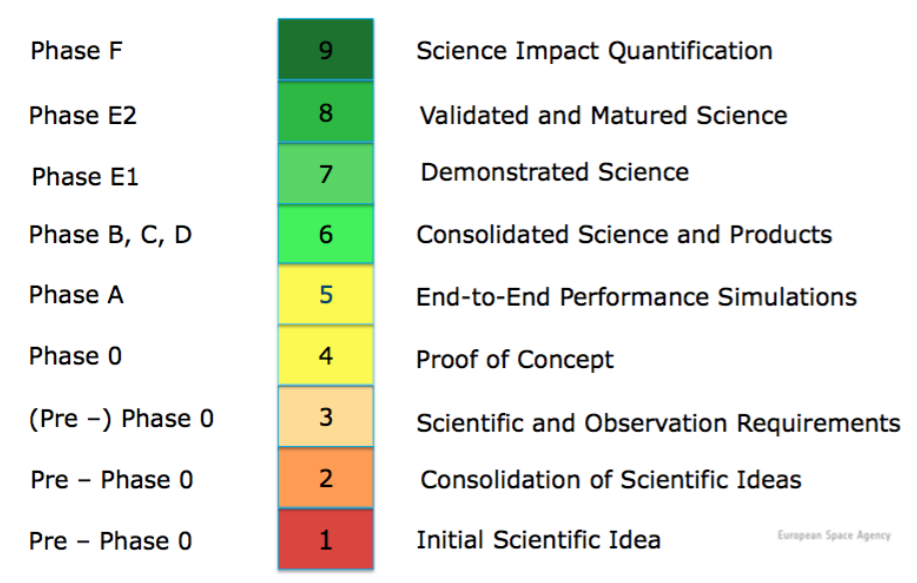
| 11 | Scientific readiness | SRL / TRL. | srl03 |
| 12 | File format | Data format, commonly tif for rasters. | .tif |
Examples
An early pre-beta SOC density mosaic (30 m, 2023–2024, topsoil 0–30 cm):
text
ogcrt33_sockgm3_m_30m_bg0..30cm_20230101_20241231_eu01_epsg3035_v1.0.1_srl04.tifA derived product (25-year trend, tm) inherits the input specifications:
text
ogcrt33_bsockgm3_tm_30m_bg0..30cm_20000101_20241231_eu01_epsg3035_v1.0.1_srl04.tifVariable-type codes
| Code | Meaning |
|---|---|
m | Mean prediction value (sums, differences) |
d | Median (Q050) |
c | Class / factor (requires a coded domain) |
cdD | Change class (2D cross-domain matrix) |
pc | Percent cover of the pixel (0–100%) |
p | Probability (0–100%) |
q005 | 5% quantile (one-sided) |
q095 | 95% quantile (one-sided) |
l159 | Lower 68% prediction-interval threshold |
u841 | Upper 68% prediction-interval threshold |
sse | Shannon Scaled Entropy |
sd | Standard deviation / prediction error (SD2 for 2σ) |
md | Model deviation (ensembles) |
si | Confidence-interval range for the mean |
td | Cumulative difference (time series) |
tm | Temporal trend (fitted β coefficient) |
Recommended readiness levels
TRL (European Commission)
- TRL03 — Experimental proof of concept: early pre-beta, testing only.
- TRL04 — Validated in lab: early beta, tied to a publication, public with disclaimer.
- TRL05 — Validated in relevant environment: beta, ready for (commercial) use, at your own risk.
- TRL06 — Demonstrated in relevant environment: official release with disclaimer.
- TRL07 — System prototype in operational environment: final release for decision-making & policy.
SRL (ESA Science Readiness Levels)
Why this convention?
- Files are easily sorted and searched (single-line bash queries; GDAL operations can be generated from the name).
- Naming patterns build virtual mosaics and composites seamlessly.
- Key spatiotemporal properties are encoded in the name — users can program analysis without opening files.
- Tiles, farm plots and full mosaics all work; versioning is uniform; all names are unique; and terms of use are implied by the name.